By Capt. Vijay | Founder & Mentor, RSA Pilot Academy
“Captain, am I actually eligible to become a pilot?”
This is one of the first—and most important—questions every aspiring pilot and parent should ask.
Surprisingly, many students pay admission fees to flight schools before checking whether they even meet the basic eligibility requirements.
That’s one of the biggest mistakes you can make.
Before thinking about flight schools, countries, or airline salaries, you must first understand pilot eligibility in India.
This guide explains everything you need to know.
Quick Answer: What Is the Eligibility to Become a Pilot in India?
To pursue the standard Commercial Pilot Licence (CPL) pathway in India, you generally need:
✅ Class 12 with Physics and Mathematics (or an accepted equivalent)
✅ Meet DGCA aviation medical standards
✅ Minimum age of 18 years for the issue of a CPL
✅ Pass the required DGCA examinations
✅ Complete the prescribed flight training and flying experience
DGCA’s published CPL requirements specify 10+2 with Physics and Mathematics (or equivalent) and a minimum age of 18 years for licence issue.
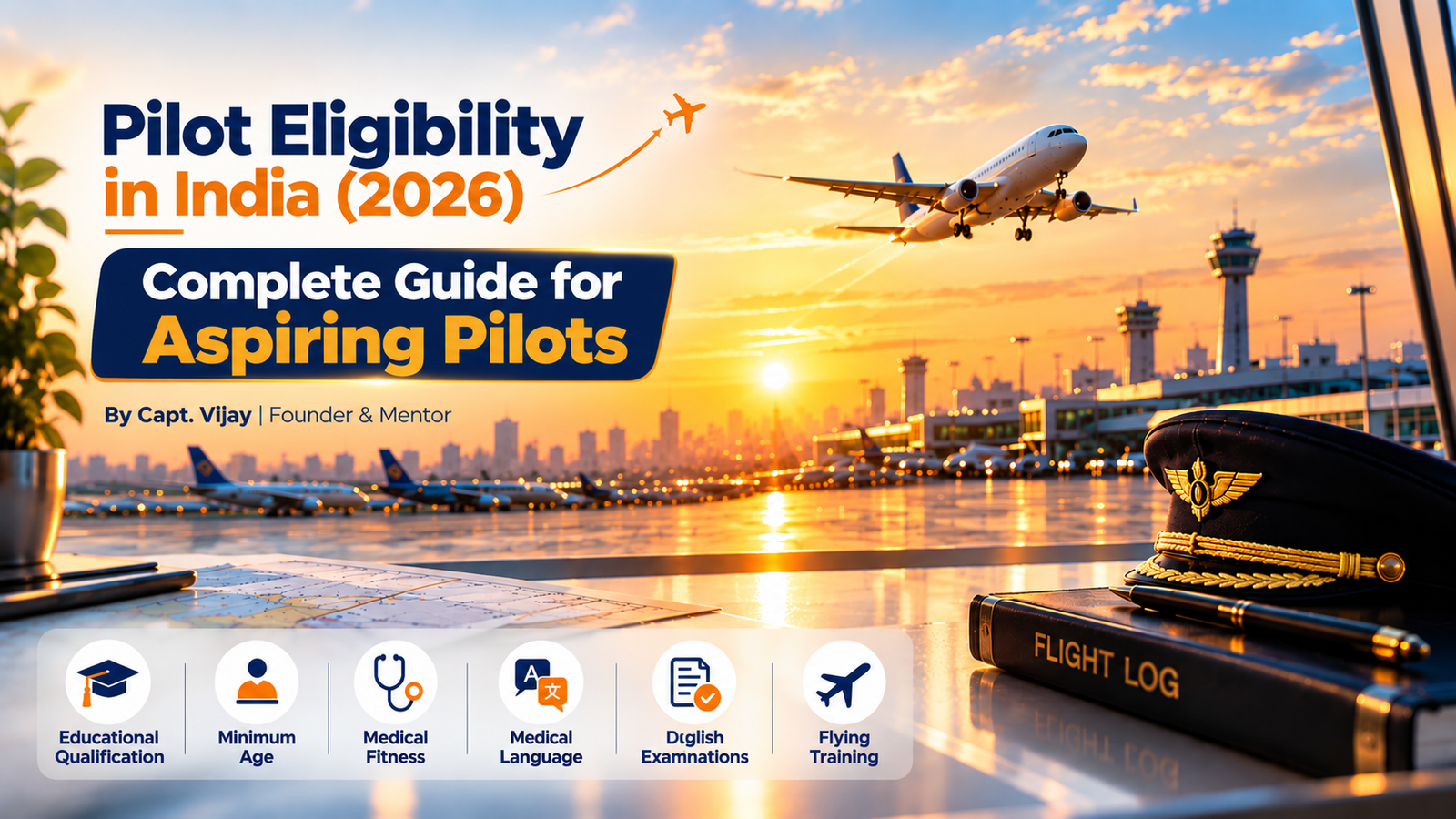
Pilot Eligibility Checklist
| Requirement | Eligibility |
|---|---|
| Educational Qualification | Class 12 with Physics & Mathematics (or accepted equivalent) |
| Minimum Age | 18 years (for CPL issue) |
| Medical Fitness | Must meet DGCA aviation medical standards |
| English Language | Should be able to communicate effectively |
| Criminal Background | Subject to airline and regulatory requirements |
| Flying Training | Complete prescribed flying experience |
| DGCA Examinations | Required subjects must be cleared |
Educational Eligibility
The most common requirement is:
- Class 12
- Physics
- Mathematics
Students often ask:
“I studied PCB.”
“I’m from Commerce.”
“I’m an Arts student.”
The good news is:
Your dream doesn’t necessarily end.
Students from non-PCM backgrounds can still become pilots after completing the required Physics and Mathematics through an accepted pathway.
Always verify your documents before beginning training.
Minimum Age Requirement
Many students think they can become airline pilots immediately after Class 12.
Here’s the reality:
You can begin preparing much earlier.
However, the Commercial Pilot Licence is generally issued only after meeting the prescribed minimum age and all licensing requirements.
This gives students enough time to complete:
- Medicals
- DGCA examinations
- Flight training
- Documentation
Medical Eligibility
One of the most overlooked requirements is medical fitness.
Every aspiring pilot should complete aviation medical planning early.
Medical fitness assesses your suitability for professional flying.
Do not assume you’re medically eligible simply because you’re healthy.
Similarly, do not assume you’re ineligible based on internet advice.
Always complete the official aviation medical process.
Can Girls Become Pilots?
Absolutely.
There is no separate CPL eligibility based on gender.
The same licensing standards apply.
India has one of the highest representations of women airline pilots globally, and opportunities continue to grow.
Can NIOS Students Become Pilots?
Yes.
Students completing their education through NIOS may become eligible, provided they satisfy the applicable DGCA educational requirements, including Physics and Mathematics where required.
Always ensure your documentation is complete before applying.
Can Diploma Students Become Pilots?
Yes.
However, your diploma alone does not automatically replace the standard educational requirements for the Indian CPL pathway.
Students should verify whether they also meet the required Physics and Mathematics eligibility.
Does Percentage Matter?
This is another common misconception.
There is no universal DGCA minimum percentage requirement for obtaining a Commercial Pilot Licence.
However:
Some airline cadet programmes, universities or scholarship programmes may have their own academic requirements.
Your marks are important—but they don’t decide what kind of pilot you’ll become.
Your discipline does.
What Skills Do Airlines Actually Look For?
Besides meeting eligibility, successful pilots develop:
- Communication skills
- Decision-making
- Situational awareness
- Leadership
- Discipline
- Teamwork
- Technical knowledge
- Professional attitude
Airlines hire professionals—not just students with licences.
Common Mistakes Students Make
Avoid these mistakes:
- Not checking eligibility before paying fees
- Ignoring aviation medicals
- Believing percentage alone decides success
- Choosing the wrong Class 11 stream
- Assuming every overseas course automatically qualifies in India
- Ignoring licence-conversion requirements
- Depending only on question banks
- Starting without a financial plan
Planning correctly before training saves time and money.
Capt. Vijay’s Advice
Every year, I meet students who say:
“Captain, I wish I had checked my eligibility earlier.”
Don’t make that mistake.
Before investing years of effort and your parents’ savings:
✔ Confirm your educational eligibility.
✔ Complete your aviation medical planning.
✔ Understand the complete pilot roadmap.
A successful aviation career starts with informed decisions—not rushed admissions.
Frequently Asked Questions
Can I become a pilot without Physics and Mathematics?
Not directly through the standard Indian CPL pathway. Students can complete the required subjects through an accepted equivalent pathway before proceeding.
Is there a minimum percentage required?
There is no universal DGCA minimum percentage for a CPL. However, individual airlines or cadet programmes may prescribe their own academic criteria.
Is 18 years compulsory?
Yes. The minimum age for the issue of a Commercial Pilot Licence is 18 years.
Can PCB, Commerce or Arts students become pilots?
Yes, after completing the required Physics and Mathematics eligibility through an accepted route.
Do I need perfect eyesight?
Not necessarily. Aviation medical standards evaluate vision based on specific criteria, and many correctable vision conditions are acceptable. Eligibility should always be determined through the official aviation medical process.
How RSA Pilot Academy Helps
RSA Pilot Academy helps aspiring pilots understand their eligibility before they invest in training by providing:
- Career counselling
- Eligibility assessment
- DGCA Ground School
- Aviation medical guidance
- Flight school selection
- Education loan guidance
- Licence conversion support
- Type Rating guidance
- Airline preparation
The goal is to help students make the right decisions before beginning their aviation journey.
Final Thoughts
Pilot eligibility is more than a checklist.
It is the foundation of your aviation career.
Before choosing a flight school…
Before comparing countries…
Before calculating costs…
First ask:
“Am I eligible?”
Once that question is answered, every other decision becomes much easier.
The cockpit belongs to students who prepare well—not just those who dream big.
Your Success Is Our Focus. Your Career Is Our Priority.