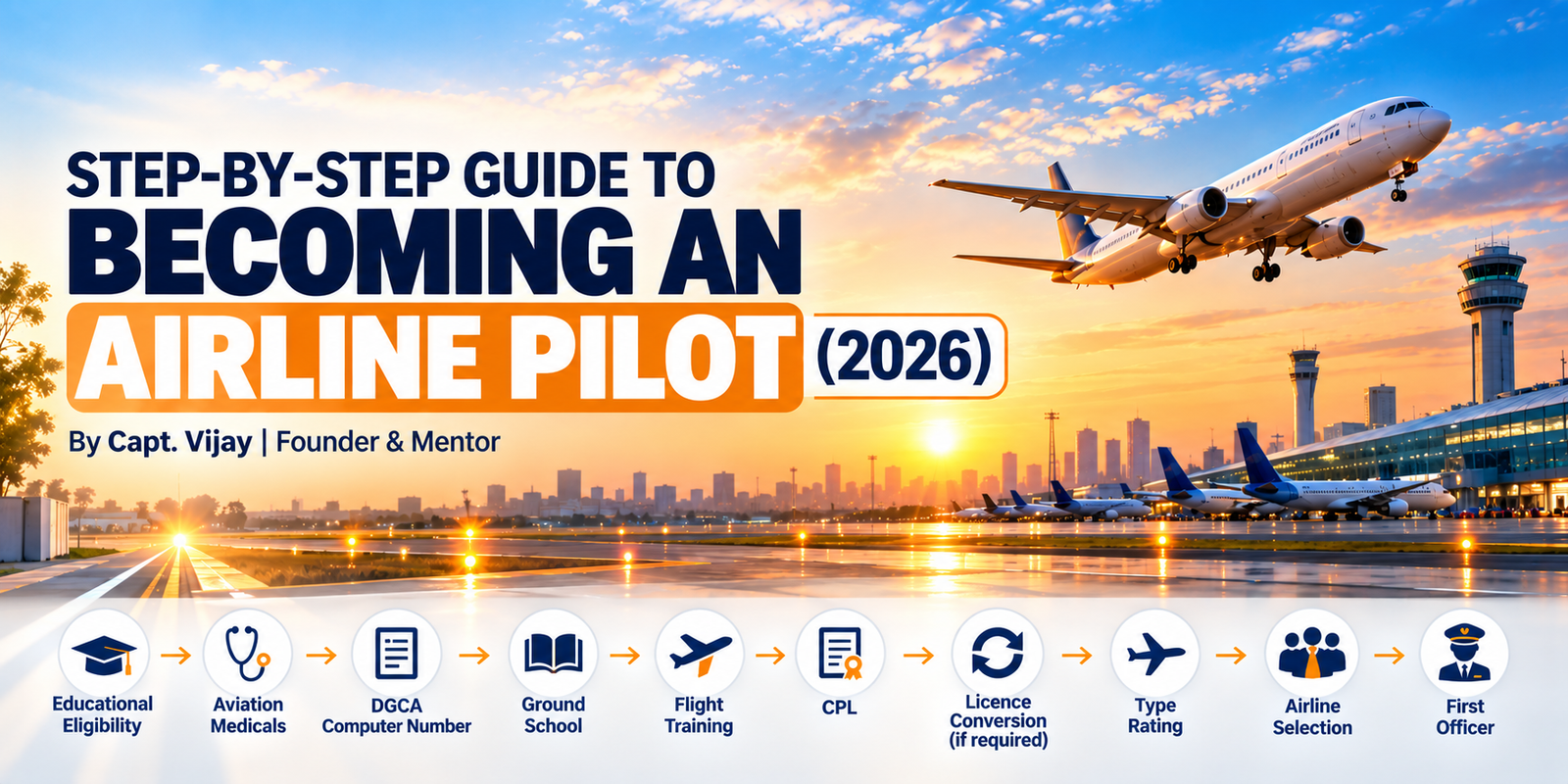
By Capt. Vijay | Founder & Mentor, RSA Pilot Academy
“Captain, I don’t just want to become a pilot… I want to become an airline pilot.”
That’s a wonderful dream.
But here’s something every aspiring pilot should understand.
A Commercial Pilot Licence (CPL) is not the finish line. It’s the beginning.
Many students believe that once they complete flight training, an airline job automatically follows. In reality, becoming an airline pilot is a carefully planned journey involving education, medical fitness, DGCA examinations, flight training, licensing, airline preparation and continuous learning.
If you’re serious about flying for an airline, this roadmap will help you understand every step.
Quick Answer: How Do You Become an Airline Pilot?
The typical pathway is:
Class 12 Eligibility → Aviation Medicals → DGCA Computer Number → Ground School → Flight Training → Commercial Pilot Licence (CPL) → Licence Conversion (if applicable) → Type Rating (depending on the pathway) → Airline Selection Process → First Officer
Each stage builds the foundation for the next.
Step 1: Complete Your Educational Eligibility
To follow the standard DGCA Commercial Pilot Licence pathway in India, you should have completed Class 12 with Physics and Mathematics (or an accepted equivalent).
Students from Arts, Commerce or PCB backgrounds can still become pilots after completing the required eligibility through an accepted route.
Never begin flight training without confirming your eligibility.
Step 2: Complete Your Aviation Medicals
Medical fitness is one of the first checkpoints in your aviation journey.
Before investing significant time and money, complete the appropriate DGCA aviation medical process to confirm that you meet the required standards.
Starting medical planning early helps avoid unnecessary delays later.
Step 3: Apply for Your DGCA Computer Number
A Computer Number is your unique identification for DGCA flight crew examinations.
Prepare your documents carefully, including educational certificates and identity documents, before applying.
Many students lose valuable time because of avoidable documentation errors.
Step 4: Join DGCA Ground School
Professional pilots don’t simply learn to fly—they learn why aircraft operate the way they do.
You’ll study subjects such as:
- Air Navigation
- Aviation Meteorology
- Air Regulations
- Technical General
- Technical Specific
- RTR(A)
Strong concepts make practical flying easier and prepare you for airline technical interviews.
Step 5: Choose the Right Flight School
This may be one of the most important decisions of your career.
When comparing flight schools, evaluate:
- Safety standards
- Instructor quality
- Aircraft availability
- Maintenance support
- Weather conditions
- Student support
- Training efficiency
- Licence-conversion guidance
- Overall transparency
Never choose a school based only on price.
The cheapest option isn’t always the best investment.
Step 6: Complete Flight Training
During practical flying, you’ll learn:
- Aircraft handling
- Take-offs and landings
- Navigation
- Instrument flying
- Night flying
- Radio communication
- Emergency procedures
- Decision-making
Every flight should improve your confidence—not just increase your logbook hours.
Step 7: Obtain Your Commercial Pilot Licence (CPL)
Once you’ve completed the applicable:
- Educational requirements
- Medical standards
- DGCA examinations
- Required flying experience
- Skill tests
- Documentation
you can apply for your Commercial Pilot Licence.
This qualifies you to pursue professional flying opportunities.
Step 8: Complete Licence Conversion (If Required)
Students who complete flight training outside India may need to complete the applicable DGCA licence-conversion process before pursuing airline opportunities in India.
This is why understanding the complete pathway before choosing a country is extremely important.
Step 9: Type Rating
Many airline pathways require pilots to complete a Type Rating on a specific aircraft such as the Airbus A320 or Boeing 737.
Type Rating teaches you to operate a particular aircraft safely using airline-standard procedures and advanced simulators.
Step 10: Prepare for Airline Selection
Airlines recruit professionals—not just licence holders.
The recruitment process may include:
- Technical examinations
- Psychometric assessments
- Aptitude tests
- HR interviews
- Group discussions
- Simulator assessments
- Background verification
Communication, discipline and professionalism matter just as much as flying ability.
Airline Pilot Roadmap
| Stage | Goal |
|---|---|
| Educational Eligibility | Meet Class 12 requirements |
| Medicals | Confirm fitness |
| Computer Number | Register for DGCA examinations |
| Ground School | Build aviation knowledge |
| Flight School | Learn practical flying |
| CPL | Obtain professional licence |
| Licence Conversion | Complete if required |
| Type Rating | Learn airline aircraft |
| Airline Preparation | Clear recruitment process |
| First Officer | Begin your airline career |
Common Mistakes to Avoid
- Starting without medical clearance
- Choosing a flight school based only on fees
- Ignoring hidden training costs
- Memorising question banks without understanding concepts
- Assuming CPL guarantees an airline job
- Neglecting communication skills
- Underestimating airline interviews
- Failing to plan finances for the complete journey
Remember:
Airlines hire competent, professional pilots—not simply students with flying hours.
Capt. Vijay’s Advice
Every student dreams of wearing an airline uniform.
But airlines don’t recruit dreams.
They recruit discipline.
Every exam you prepare for, every concept you understand, every safe decision you make and every professional habit you build brings you one step closer to the cockpit.
Don’t rush to finish training.
Focus on becoming the kind of pilot an airline can trust.
Frequently Asked Questions
How long does it take to become an airline pilot?
The timeline varies depending on examination schedules, flight-school efficiency, aircraft availability, weather, licence processing and airline recruitment.
Does a CPL guarantee an airline job?
No. A CPL is a professional licence. Airline recruitment depends on technical knowledge, assessments, vacancies and individual performance.
Is Type Rating compulsory?
Many airline pathways require a Type Rating before operating a specific aircraft type. The exact requirement depends on the airline and pathway.
Can I become an airline pilot after training abroad?
Yes, provided you complete the applicable licence-conversion requirements and satisfy airline recruitment criteria.
How RSA Pilot Academy Helps
RSA Pilot Academy guides aspiring pilots through every stage of the journey by offering:
- Career counselling
- DGCA Ground School
- Aviation medical guidance
- Flight-school selection
- Education-loan guidance
- Licence-conversion planning
- Type Rating guidance
- Airline interview preparation
The focus is not only on helping students obtain a licence—but on preparing them for a successful airline career.
Final Thoughts
The journey to becoming an airline pilot is built one step at a time.
There are no shortcuts.
Complete your eligibility.
Strengthen your aviation knowledge.
Choose the right flight school.
Fly with discipline.
Prepare beyond the CPL.
And remember—the airline cockpit isn’t awarded to the fastest student.
It’s earned by the most prepared professional.
Your Success Is Our Focus. Your Career Is Our Priority.