By Capt. Vijay | Founder and Mentor, RSA Pilot Academy
“Captain, I have completed Class 12. What should I do first—join ground school, complete my medicals or select a flight school?”
This is where many aspiring pilots make their first costly mistake.
They rush into a course without understanding the complete journey.
Becoming an airline pilot is not one admission. It is a sequence of carefully planned stages involving educational eligibility, aviation medicals, DGCA examinations, flight training, licensing and airline preparation.
Quick Answer: What Should You Do After Class 12?
The standard roadmap is:
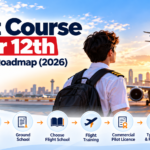
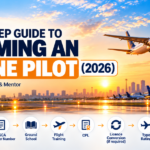
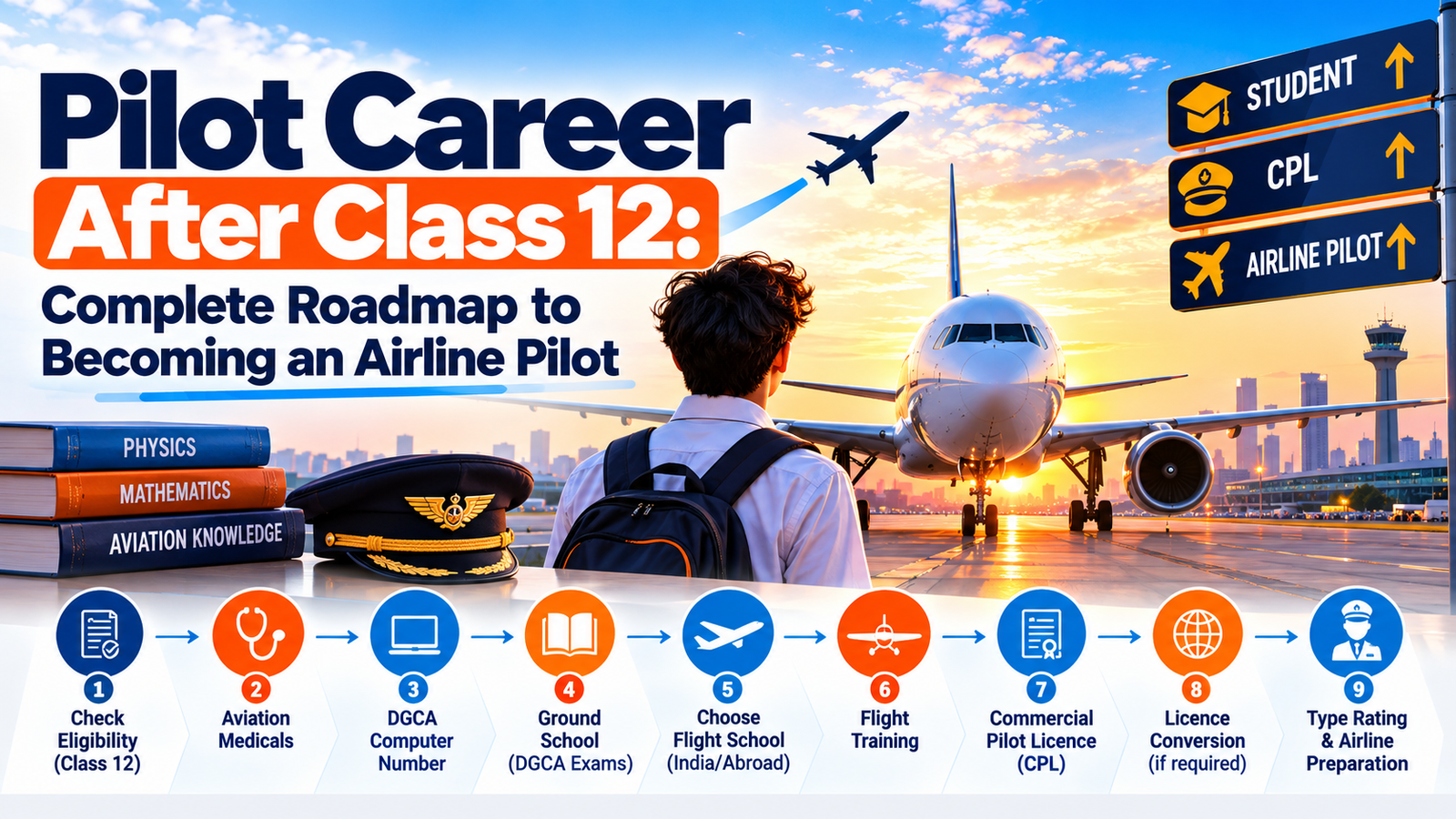
Eligibility verification → Aviation medicals → DGCA Computer Number → Ground School → Flight-school selection → Flight training → Commercial Pilot Licence → Licence conversion, if required → Type Rating and airline preparation
For the Indian Commercial Pilot Licence pathway, applicants must have passed Class 12—or an accepted equivalent examination—with Physics and Mathematics. The minimum age for the issue of a CPL is 18 years.
Step 1: Confirm Your Educational Eligibility
Check your Class 12 marksheet before making any payment.
You should have passed:
- Physics
- Mathematics
Students from PCB, Arts or Commerce backgrounds can still become pilots, but they may need to complete the missing subjects through a recognised and accepted route.
Your overall percentage does not automatically decide your potential as a pilot. However, individual cadet programmes, universities or airlines may apply their own academic cut-offs.
Step 2: Begin Your Aviation Medical Process
Medical fitness should be assessed early.
Do not wait until after paying a large flight-school deposit to discover a medical concern.
Aspiring commercial pilots should complete the applicable DGCA medical process at the appropriate stages and maintain medical fitness throughout their professional careers.
Step 3: Apply for a DGCA Computer Number
A Computer Number is your permanent identification for DGCA flight-crew examinations.
The DGCA Pariksha portal is the official platform used for future flight-crew examinations. Candidates must register on the portal using their Computer Number.
Ensure that your:
- Name
- Date of birth
- Educational documents
- Identity records
are consistent and correctly uploaded.
Even minor documentation errors can delay your examination journey.
Step 4: Join DGCA Ground School
Pilot training is not only practical flying.
You must build strong concepts in subjects such as:
- Air Navigation
- Aviation Meteorology
- Air Regulations
- Technical General
- Technical Specific
- RTR(A)
Question banks are valuable for practice, but they cannot replace conceptual understanding.
A professional pilot must know why an answer is correct and how that knowledge applies inside an aircraft.
Step 5: Choose India or Overseas Flight Training
This decision should depend on more than the country name.
Compare:
| Factor | Why It Matters |
|---|---|
| Aircraft availability | Affects training continuity |
| Instructor strength | Influences learning quality |
| Weather | Can affect flying frequency |
| Maintenance support | Improves safety and availability |
| Completion history | More useful than advertised timelines |
| Licence conversion | Important after overseas training |
| Total investment | Must include living and hidden expenses |
The best country is not automatically the one with the cheapest brochure.
The best option is the school and pathway that suit your goals, finances and licensing plan.
Step 6: Complete Flight Training
During flying training, you will learn:
- Aircraft handling
- Take-offs and landings
- Cross-country navigation
- Instrument flying
- Night flying
- Radio communication
- Emergency procedures
- Flight planning
- Aeronautical decision-making
Do not chase only the required flying hours.
Make every hour improve your skill, confidence and judgement.
Step 7: Obtain Your Commercial Pilot Licence
After completing the applicable educational, medical, examination, flying, skill-test and documentation requirements, you can apply for your CPL.
A CPL qualifies you for professional flying within the privileges and conditions of the licence.
However, it does not automatically guarantee an airline job.
Step 8: Complete Licence Conversion, If Required
Students who train abroad and want an Indian CPL must satisfy the applicable DGCA conversion requirements.
This may involve specific examinations, flying requirements, documentation and skill tests.
Understand the conversion process before selecting an overseas flight school—not after returning to India.
Step 9: Prepare for Airline Selection
Airline recruitment may include:
- Technical examinations
- Aptitude tests
- Psychometric assessments
- Group exercises
- HR interviews
- Simulator assessments
- Background verification
- Type Rating, depending on the pathway
Airlines recruit professionals, not merely licence holders.
Your communication, technical knowledge, attitude, discipline and decision-making all matter.
Common Mistakes After Class 12
Avoid:
- Paying a flight school before medical planning
- Choosing a school based only on fees
- Depending entirely on question banks
- Ignoring licence conversion
- Assuming the fastest advertised timeline is guaranteed
- Beginning without a complete financial plan
- Believing a CPL guarantees airline employment
Frequently Asked Questions
Can I start pilot training immediately after Class 12?
Yes, once you meet the applicable educational, medical and documentation requirements.
Is a degree compulsory?
A university degree is not generally required for the standard Indian CPL pathway. Individual airlines or programmes may apply separate criteria.
Can PCB, Arts or Commerce students become pilots?
Yes, after completing the required Physics and Mathematics eligibility through an accepted route.
How long does the journey take?
The timeline varies with examinations, medicals, weather, aircraft availability, licence processing and airline recruitment.
What should I do first after Class 12?
Begin with eligibility verification and aviation medical planning—not flight-school payment.
How RSA Pilot Academy Helps
RSA Pilot Academy supports students with:
- Pilot career counselling
- Eligibility and documentation guidance
- DGCA Ground School
- Aviation medical guidance
- Flight-school selection
- India and overseas comparisons
- Education-loan assistance
- Licence conversion
- Type Rating guidance
- Airline-selection preparation
The objective is to help students understand the entire journey before making a major career investment.
Final Thoughts
Your pilot career after Class 12 should begin with clarity—not urgency.
Verify your eligibility.
Complete your medical planning.
Build strong theoretical knowledge.
Choose your flight school carefully.
Learn from every flying hour.
Then prepare beyond the CPL for the airline cockpit.
A successful pilot career does not begin when you first touch the controls.
It begins when you make the right decisions before training.
Your Success Is Our Focus. Your Career Is Our Priority.