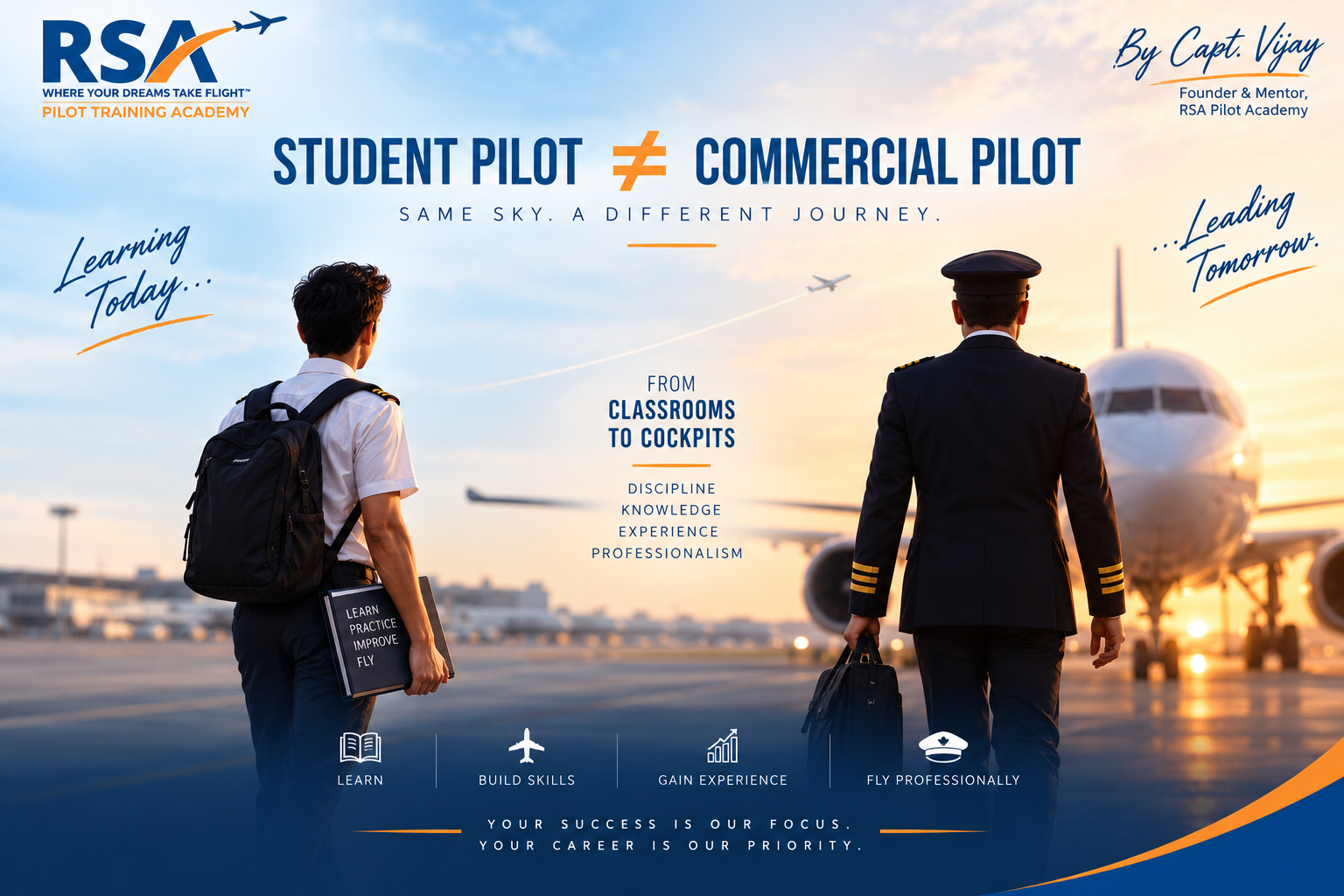
By Capt. Vijay | Founder & Mentor, RSA Pilot Academy
“Captain, I’m learning to fly. Does that make me a commercial pilot?”
This is one of the biggest misconceptions among aspiring pilots.
Many students complete a few flying lessons and proudly say they’re “commercial pilots.”
The reality is very different.
A Student Pilot is someone learning to fly.
A Commercial Pilot is a licensed professional who has completed the required training, examinations, flying experience and licensing requirements to fly commercially within the privileges of the licence.
Understanding this difference helps students set realistic expectations and avoid disappointment during their aviation journey.
Quick Answer
A Student Pilot is in training.
A Commercial Pilot has successfully completed the required Commercial Pilot Licence (CPL) requirements and is legally qualified to exercise the privileges of that licence, subject to applicable regulations.
Every commercial pilot was once a student pilot—but not every student pilot automatically becomes a commercial pilot.
The journey requires dedication, discipline and continuous learning.
Student Pilot vs Commercial Pilot
| Student Pilot | Commercial Pilot |
|---|---|
| Learning to fly | Professionally licensed pilot |
| Under instructor supervision | Can exercise CPL privileges subject to regulations |
| Building flying skills | Completed required flying training and licensing |
| Studying aviation subjects | Applies aviation knowledge professionally |
| Learning aircraft handling | Responsible for safe aircraft operation within licence privileges |
| Focused on learning | Focused on operational safety and professionalism |
The biggest difference isn’t the uniform.
It’s the responsibility.
The Journey from Student to Commercial Pilot
Every pilot begins the same way.
Step 1 – Ground School
Students first develop strong theoretical knowledge in:
- Air Navigation
- Aviation Meteorology
- Air Regulations
- Technical Subjects
- RTR(A)
Without good theory, practical flying becomes much harder.
Step 2 – Flight Training
Students gradually learn:
- Aircraft controls
- Taxiing
- Take-offs
- Landings
- Radio communication
- Navigation
- Instrument flying
- Emergency procedures
This stage builds confidence—but students are still learning.
Step 3 – Skill Development
With experience, students improve:
- Situational awareness
- Decision-making
- Flight planning
- Weather interpretation
- Crew coordination
- Aviation discipline
Flying an aircraft safely requires much more than controlling the controls.
Step 4 – Commercial Pilot Licence
After completing the applicable educational, medical, examination, flying and licensing requirements, students can qualify for a Commercial Pilot Licence.
This is where a student pilot becomes a professional pilot.
What Changes After Becoming a Commercial Pilot?
Many students think everything changes overnight.
Actually, learning continues.
Commercial pilots continue improving through:
- Recurrent training
- Simulator sessions
- Airline standard operating procedures
- Type Rating
- Line training
- Technical refreshers
- Safety programmes
A CPL is not the end of learning.
It’s the beginning of a professional aviation career.
Skills Every Student Pilot Should Develop
The best student pilots focus on much more than flying hours.
Successful students build:
- Discipline
- Time management
- Communication
- Technical knowledge
- Decision-making
- Situational awareness
- Professional attitude
- Safety mindset
Airlines recruit professionals—not just licence holders.
Common Mistakes Student Pilots Make
❌ Chasing flying hours instead of learning.
❌ Depending only on question banks.
❌ Ignoring aviation theory.
❌ Comparing themselves with others.
❌ Thinking CPL guarantees an airline job.
❌ Underestimating communication skills.
❌ Believing practical flying is easier than theory.
Remember:
Good pilots never stop learning.
Student Pilot vs Commercial Pilot Mindset
| Student Pilot Thinks | Commercial Pilot Thinks |
|---|---|
| “How do I pass?” | “How do I fly safely?” |
| “How many hours do I need?” | “How do I improve every flight?” |
| “How do I clear the exam?” | “How do I make the right operational decision?” |
| “How fast can I finish?” | “How well can I perform?” |
Professionalism begins long before your first airline interview.
Capt. Vijay’s Advice
One lesson I tell every student:
Don’t chase the licence.
Chase the pilot you are becoming.
The CPL is only a certificate.
Your discipline, knowledge, judgement and professionalism are what airlines truly value.
If you become an excellent student pilot, becoming an excellent commercial pilot becomes much easier.
Frequently Asked Questions
Is a student pilot a commercial pilot?
No. A student pilot is still undergoing training, while a commercial pilot has completed the applicable licensing requirements.
Can student pilots fly alone?
Student pilots may complete supervised solo flights when authorised by their instructor and in accordance with applicable regulations and training requirements.
Does a Commercial Pilot Licence guarantee an airline job?
No. Airline recruitment depends on vacancies, qualifications, assessments, medical fitness and individual airline requirements.
What is the biggest difference between a student pilot and a commercial pilot?
Responsibility.
Commercial pilots are expected to apply professional knowledge, judgement and discipline in every flight.
How long does it take to become a commercial pilot?
The timeline varies depending on examinations, weather, aircraft availability, medicals, documentation and training efficiency.
How RSA Pilot Academy Helps Students
RSA Pilot Academy supports aspiring pilots throughout the journey by providing:
- Career counselling
- DGCA Ground School
- Flight school selection guidance
- Aviation medical assistance
- Education loan guidance
- Licence conversion support
- Type Rating guidance
- Airline interview preparation
The objective is not just to help students obtain a licence—but to prepare them for a successful professional aviation career.
Final Thoughts
Every airline captain was once a nervous student pilot.
The difference wasn’t talent alone.
It was consistency.
Every lesson learned.
Every mistake corrected.
Every concept understood.
Every safe decision made.
Don’t focus only on becoming a commercial pilot.
Focus on becoming the kind of pilot airlines trust with hundreds of lives every day.
Because a licence may open the cockpit door…
But professionalism keeps you there.
Your Success Is Our Focus. Your Career Is Our Priority.