By Capt. Vijay | Founder and Mentor, RSA Pilot Academy
“Captain, how much does it actually cost to become a pilot in India?”
Most parents expect one simple figure.
Unfortunately, many brochures show only the flight-training fee—not the complete investment required to reach the Commercial Pilot Licence stage.
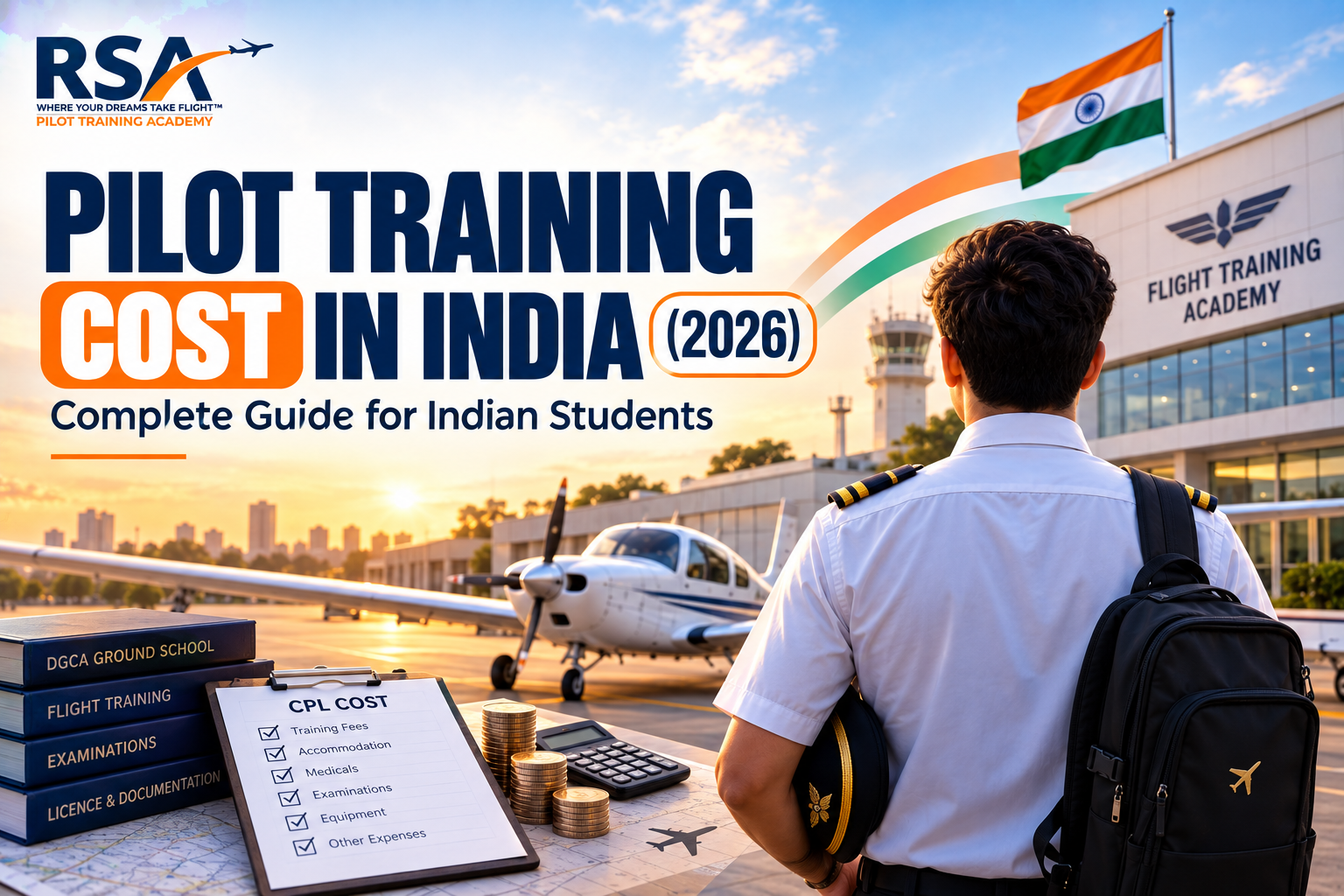
In 2026, students should generally plan for approximately ₹55 lakh to ₹75 lakh to complete a conventional CPL pathway in India, including flying, ground school and essential supporting expenses. The final amount depends on the academy, aircraft type, taxes, accommodation, additional flying and training delays.
For comparison, IGRUA currently lists its ab-initio CPL course at ₹55 lakh plus applicable GST, while CAE Gondia lists a CPL fee of approximately ₹58 lakh, with about ₹8 lakh estimated separately for food, accommodation and related expenses.
Quick Answer: What Is the Pilot Training Cost in India?
| Expense | Approximate Planning Range |
|---|---|
| DGCA Ground School | ₹1.5–₹3 lakh |
| Aviation medicals | ₹25,000–₹75,000 |
| DGCA examinations and documentation | ₹25,000–₹1 lakh |
| CPL flight training | ₹50–₹60 lakh or more |
| Accommodation and living | ₹3–₹8 lakh |
| Equipment and study material | ₹50,000–₹2 lakh |
| Estimated CPL-stage investment | ₹55–₹75 lakh |
These are planning ranges, not guaranteed quotations.
The conventional Indian CPL pathway currently requires the prescribed educational, medical, examination and flying requirements. DGCA’s published rules continue to require Class 12 or equivalent with Physics and Mathematics for the standard CPL pathway.
Why Do Pilot-Training Fees Vary So Much?
Aircraft Type
Training on newer or more advanced aircraft can cost more per hour.
Multi-engine aircraft and advanced simulators also have higher hourly rates. IGRUA, for example, separately lists higher rates for its Diamond DA42 aircraft than for the single-engine DA40.
Fuel and Maintenance
Fuel is one of the largest operating costs for a flight school.
Aircraft parts, maintenance and imported equipment can also become more expensive when fuel prices rise or the rupee weakens.
Training Duration
A longer course means additional spending on:
- Accommodation
- Food
- Local transport
- Repeated travel
- Additional simulator sessions
- Licence renewals or document updates
Time is not only a scheduling issue.
It is a financial issue.
Additional Flying Hours
Not every student becomes skill-test ready at exactly the minimum planned number of hours.
Additional practice may be required because of:
- Long gaps between flights
- Weak fundamentals
- Change of instructor
- Aircraft transition
- Repeated checks
- Individual learning progress
The Brochure Fee Is Not Always the Final Cost
Before paying any academy, ask whether the quotation includes:
- Ground-school tuition
- Required flight-training hours
- Multi-engine flying
- Simulator sessions
- Fuel surcharges
- Instructor charges
- Check flights
- Examiner fees
- Medicals
- DGCA examinations
- Documentation
- Study material
- Uniform and headset
- Accommodation and meals
- Taxes
- Additional flying-hour rates
A package priced lower at admission can become more expensive if important items are excluded.
CPL Cost vs Airline-Ready Cost
This distinction is extremely important.
CPL-Stage Cost
This generally includes:
- Ground school
- Aviation medicals
- DGCA examinations
- Flight training
- Skill tests
- CPL documentation
Airline-Ready Investment
Depending on the chosen pathway, students may later require:
- Type Rating
- Airline preparation
- Simulator training
- Licence or rating renewals
- Travel and accommodation
- Additional technical preparation
Cadet programmes may bundle more stages into one package. CAE currently estimates its IndiGo Cadet Pilot Programme at approximately ₹97 lakh, illustrating why a cadet programme should not be compared directly with a basic CPL quotation.
How Can Parents Control the Total Cost?
Compare Complete Written Quotations
Compare inclusions, exclusions and tax—not just the headline fee.
Check Operational Aircraft Availability
A large advertised fleet is not useful if only a few aircraft are serviceable.
Ask for Average Completion Time
Ask how long recent students actually took, not the shortest possible timeline.
Keep a Financial Buffer
Families should retain a contingency amount for:
- Additional flying
- Training delays
- Medical reviews
- Accommodation extensions
- Travel
- Licence processing
Avoid Starting with Partial Funding
Interrupting training because funds run out can create long flying gaps, additional revision and extra hours.
Common Financial Mistakes
- Believing the brochure fee is all-inclusive
- Comparing only the cost per flying hour
- Ignoring GST and other taxes
- Forgetting accommodation and meals
- Assuming no extra flying will be required
- Paying before completing medical planning
- Spending the entire budget before the post-CPL stage
- Believing CPL guarantees immediate airline employment
Frequently Asked Questions
What is the minimum CPL cost in India?
Published fees from established providers currently begin around the mid-₹50 lakh range before all personal and supporting expenses. A realistic complete CPL-stage budget is often higher.
Is ₹40 lakh enough to become a pilot in India?
For most current conventional CPL pathways, ₹40 lakh may be insufficient once complete flying, ground school, accommodation, taxes and related expenses are included.
Does CPL cost include Type Rating?
Usually not, unless the written package specifically includes it. Always verify the inclusions.
Is the cheapest flight school the best option?
No. Delays, low aircraft availability and excluded charges can make a cheaper school more expensive overall.
Capt. Vijay’s Advice
Do not ask only:
“What is the course fee?”
Ask:
“What will our total investment be until the student is ready for the next professional stage?”
Parents are not investing only in flying hours.
They are investing in training quality, safety, continuity and their child’s future.
How RSA Pilot Academy Helps
RSA Pilot Academy supports students and parents with:
- Career counselling
- DGCA Ground School
- Medical guidance
- Flight-school comparisons
- Education-loan assistance
- Cost and inclusion analysis
- Licence-conversion planning
- Type Rating guidance
- Airline preparation
The objective is to help families understand the complete pathway before committing their savings or taking an education loan.
Final Thoughts
Pilot training in India is a major investment.
The safest approach is to plan for the total journey—not the lowest advertised fee.
Compare schools carefully.
Verify every inclusion.
Complete medical planning early.
Keep a financial buffer.
And remember:
The cheapest quotation is not always the lowest final cost.
Your Success Is Our Focus. Your Career Is Our Priority.