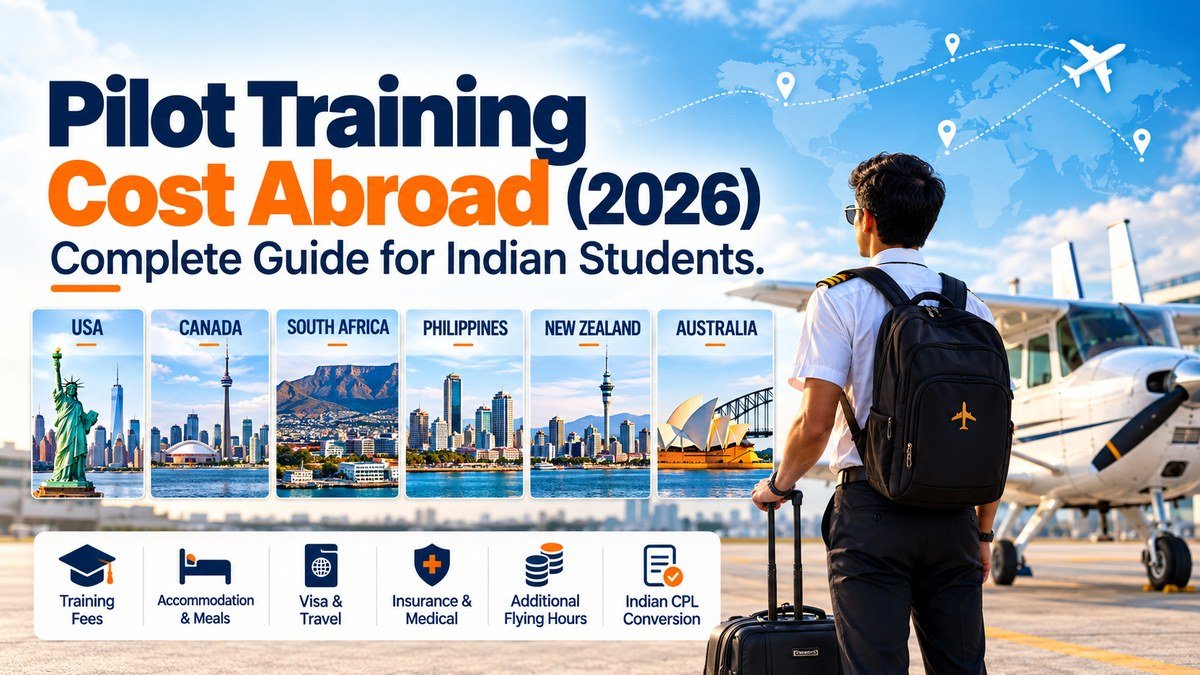
By Capt. Vijay | Founder and Mentor, RSA Pilot Academy
“Captain, is pilot training abroad cheaper than training in India?”
Sometimes it is. Sometimes it is not.
Many families compare only the advertised flying package. They later discover that accommodation, visas, insurance, licence conversion, additional flying and currency fluctuations can add several lakhs to the final investment.
For an Indian student, the correct question is:
“What will the complete cost be from admission until an Indian CPL—not just the foreign flight-school fee?”
Quick Answer: How Much Does Pilot Training Abroad Cost?
Indian students should generally plan for approximately ₹55 lakh to more than ₹1.2 crore, depending on the country, flight school, programme structure and living expenses.
| Country | Approximate Total Planning Range |
|---|---|
| Philippines | ₹55–70 lakh |
| South Africa | ₹55–70 lakh |
| Canada | ₹65–85 lakh |
| USA | ₹75 lakh–₹1 crore+ |
| New Zealand | ₹85 lakh–₹1.05 crore+ |
| Australia | ₹90 lakh–₹1.25 crore+ |
These are broad planning ranges, not school quotations. Exchange rates, additional flying and accommodation can materially change the final amount.
Current published examples show the variation. A US international airline-pilot programme lists tuition starting near US$83,866, while another academy places 2026 professional training around US$80,000–100,000.
In New Zealand, one international diploma pathway lists fees exceeding NZ$144,000. Australian institutions publish 2026 flight-training costs ranging from approximately AU$87,000 to AU$154,500, depending on programme structure and ratings.
What Does the Advertised Fee Usually Include?
A flight-training package may include:
- Ground instruction
- Single-engine flying
- Hour building
- Instrument training
- Multi-engine flying
- Simulator sessions
- Instructor charges
- Basic training material
However, every quotation is different.
Never assume “complete CPL package” means every expense until Indian licence conversion.
Expenses Commonly Excluded
Families should separately check for:
- Visa and permit fees
- Air tickets
- Medical examinations
- Health and travel insurance
- Accommodation and meals
- Local transportation
- Uniform, headset and equipment
- Examination and licence fees
- Fuel surcharges
- Examiner or checkride fees
- Additional flying hours
- Foreign-licence verification
- DGCA examinations
- Indian skill tests
- Licence-conversion expenses
- Extended accommodation after delays
The brochure price may only be the beginning.
Country-by-Country Cost Perspective
Philippines
The Philippines is often considered by students seeking a comparatively lower-cost overseas pathway.
A published Philippine estimate places CPL training around PHP 2.5–4 million, with instrument and multi-engine ratings potentially adding further cost.
Before enrolling, verify that the school appears on the current regulator-approved training-organisation list.
South Africa
South Africa can offer competitive flying rates and favourable training conditions at selected locations.
Published estimates vary widely, from around US$40,000 to US$65,000 for complete commercial training pathways.
The lowest quotation should not be selected without checking fleet availability, safety, maintenance and exclusions.
USA
The USA offers extensive airspace, airport infrastructure and a large flight-training ecosystem.
Current international programmes commonly advertise approximately US$80,000–100,000 for structured professional training.
Accommodation, insurance, visa-related expenses and DGCA conversion remain additional considerations.
Canada
Canadian programme costs differ depending on whether the student chooses standalone flying or a college pathway.
One 2026–27 commercial-pilot programme lists approximately CAD 88,250, while another college-associated pathway estimates about CAD 80,000 plus tax for flight training.
Students hoping to work in Canada must separately verify immigration and work-permit eligibility; admission to a flight school does not automatically create post-study work rights.
New Zealand and Australia
These countries can provide structured, premium training environments, but the investment is generally higher.
New Zealand international programmes may exceed NZ$140,000, while Australian CPL and multi-engine instrument pathways can exceed AU$100,000.
Do You Automatically Get an Indian CPL?
No.
A foreign Commercial Pilot Licence does not automatically become an Indian CPL.
Students returning to India must satisfy the applicable DGCA conversion requirements, which may include document verification, examinations, medical requirements and skill tests. DGCA maintains specific guidance for demonstrating competency when converting a foreign CPL.
DGCA also cautions students that it does not supervise foreign flight schools. Families must independently verify the school’s approval, safety standards, contract, fees and refund policy.
How Parents Should Compare Flight Schools
Request a written answer to these questions:
- What is the guaranteed and estimated flying-hour package?
- How many aircraft are currently operational?
- What is the average completion time?
- What happens if additional hours are required?
- Are fuel, taxes and examiner charges included?
- What are the refund and withdrawal rules?
- Is accommodation included?
- What conversion support is provided?
- Is the school approved by the national aviation regulator?
- What will the complete investment be until Indian CPL eligibility?
Common Financial Mistakes
- Comparing only training fees
- Ignoring currency fluctuations
- Assuming accommodation is included
- Starting with no emergency buffer
- Believing the shortest advertised timeline
- Paying before completing aviation medical planning
- Assuming overseas training guarantees an overseas job
- Ignoring Indian licence conversion
Capt. Vijay’s Advice
Do not choose a country first.
Choose a training pathway.
A lower hourly flying rate does not always create a lower total cost. If aircraft are unavailable, training is delayed or conversion planning is weak, the “cheaper” option may become far more expensive.
Parents should budget for the complete journey—not simply the admission invoice.
How RSA Pilot Academy Helps
RSA Pilot Academy supports students with:
- Country and flight-school comparisons
- DGCA Ground School
- Medical and documentation guidance
- Education-loan assistance
- Written cost analysis
- Licence-conversion planning
- Type Rating guidance
- Airline preparation
The aim is to help families understand the full financial and professional pathway before paying a foreign flight school.
Final Thoughts
Pilot training abroad can offer excellent exposure and efficient flying—but only when the school and pathway are chosen carefully.
Compare the complete cost.
Verify every inclusion.
Understand conversion before departure.
Keep a financial buffer.
And never allow an attractive brochure price to replace proper research.
Your Success Is Our Focus. Your Career Is Our Priority.